×

Privacy Overview

This website uses cookies so that we can provide you with the best user experience possible. Cookie information is stored in your browser and performs functions such as recognising you when you return to our website and helping our team to understand which sections of the website you find most interesting and useful.

You can adjust all of your cookie settings by navigating the tabs on the left hand side.

COOKIES REQUIRED

Cookie NameAccept
Regulamento Geral de Protecção de Dados - - PIBR PRO ALL em 1 This modules helps the site to become GDPR Compliant by adding the law compliant features.

ANALYTICAL COOKIES

Cookie NameAccept
Exportação Google These cookies are used to build a profile of your interests and show you relevant advertisements, they do not store data.
Google AdWords These cookies are used to build a profile of your interests and show you relevant advertisements, they do not store data.

ADVERTISING COOKIES

Cookie NameAccept
Exportação Google These cookies are used to build a profile of your interests and show you relevant advertisements, they do not store data.
Facebook Shop, Facebook Dynamic Ads and Instagram Shop integration via CSV feed These cookies are used to build a profile of your interests and show you relevant advertisements, they do not store data.
Google AdWords These cookies are used to build a profile of your interests and show you relevant advertisements, they do not store data.
Google ReCaptcha These cookies are used to build a profile of your interests and show you relevant advertisements, they do not store data.
Layout Melhorado

How to Sterilize Glass Bottles and Jars

December 11, 2025 Reading time: 10 minutes

Why do I need to sterilize my jars?

Glass bottles and jars can sometimes contain dirt and accumulated impurities from the time of manufacture until they reach you. As these products are used for packaging liqueurs, juices, jams, honey, and virtually any food product, they must be sterilized to ensure clean and disinfected storage.

Although this measure is especially important for packaging intended for food contact, it should be noted that sterilization also proves important when using jars and bottles to store other products such as perfumes, essential oils, and cosmetic products. This ensures that our products are packaged in their original form and without any alterations.

Is it very difficult to sterilize my jars or bottles?

Of course not! Although it may seem like a technical step, the truth is that there are several home methods for sterilizing your glass containers, and they are all relatively easy and quick to perform.

What sterilization methods can I use? There are several ways to ensure the hygiene and safety of your glass jars and bottles, but to keep it simple, in this post we will focus only on the 4 most practical methods:

  • Sterilization with boiling water (the traditional method);
  • Sterilization in the oven;
  • Sterilization in the microwave;
  • Sterilization in the dishwasher.

1. Sterilizing Jars with Boiling Water

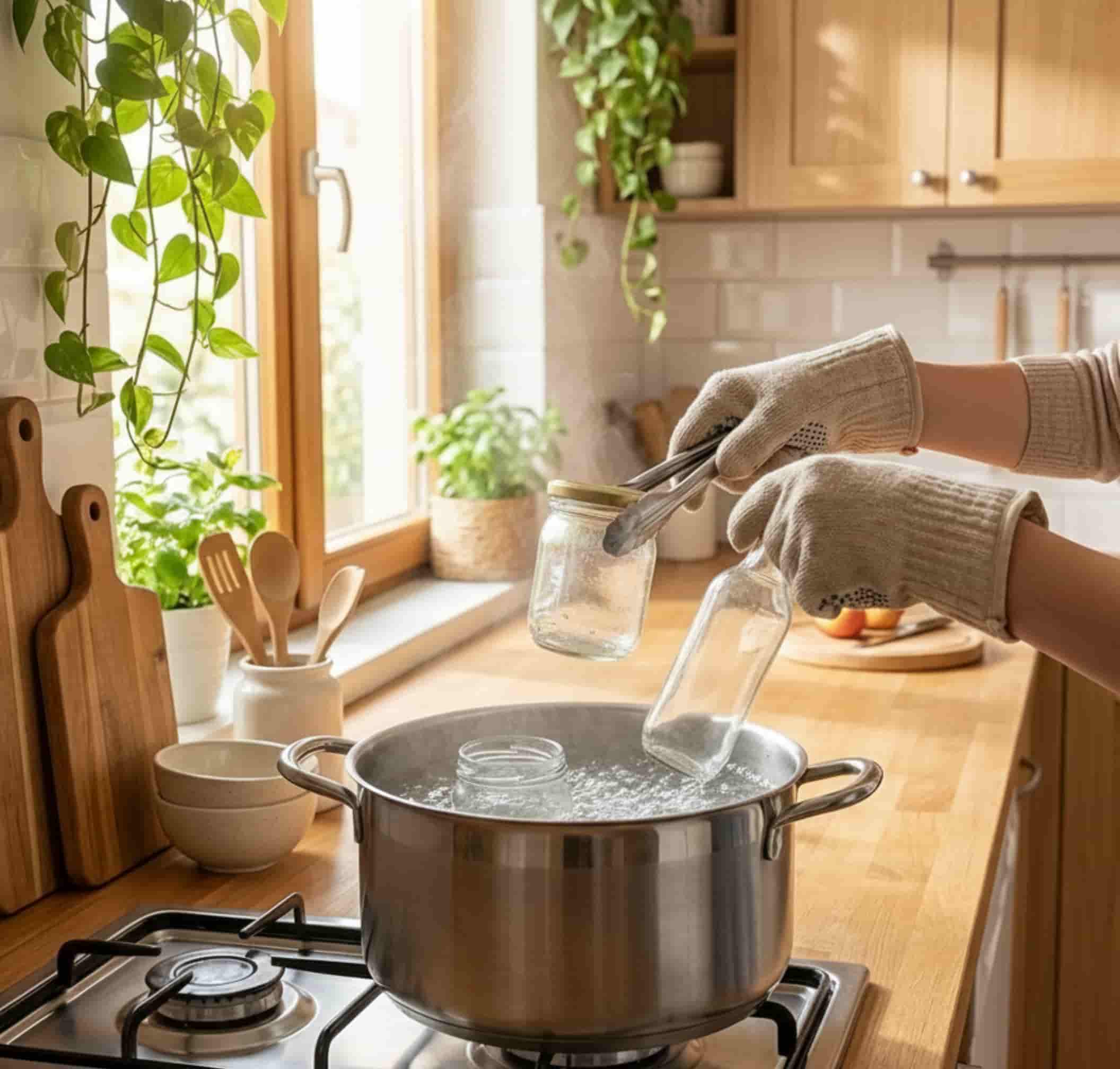
Sterilizing with boiling water is the most traditional and one of the most reliable methods for sanitizing both glass jars and lids. The high boiling temperature is effective at destroying bacteria and microorganisms that could compromise your preserves.

Follow this step-by-step:

  • 1- Wash everything beforehand: Begin by thoroughly washing the jars and bottles with hot water and dish soap. The goal is to remove dust, grease, or any manufacturing residues that may be inside.
  • 2- Prepare the pot: Fill a deep pot with water and place it on the heat. Tip: Place a clean kitchen towel at the bottom of the pot; this prevents the glass from hitting the metal and breaking during boiling.
  • 3- Boil the containers: Place the jars and bottles inside the pot (ensuring they are submerged). Let them boil for 15 minutes. If the lids are metal, add them only for the last 5 minutes so as not to damage the rubber seal.
  • 4- Dry safely: Using tongs (to avoid burning yourself), remove the jars and place them upside down on a clean cloth to drain and cool naturally before use.
  •  

Precautions:

  • 1- Be careful when removing the jars from the water; as they are hot, they can break more easily.
  • 2- Do not sterilize plastic jars, bottles, or lids in boiling water, as they may melt or deform.

2. Sterilizing Jars in the Oven

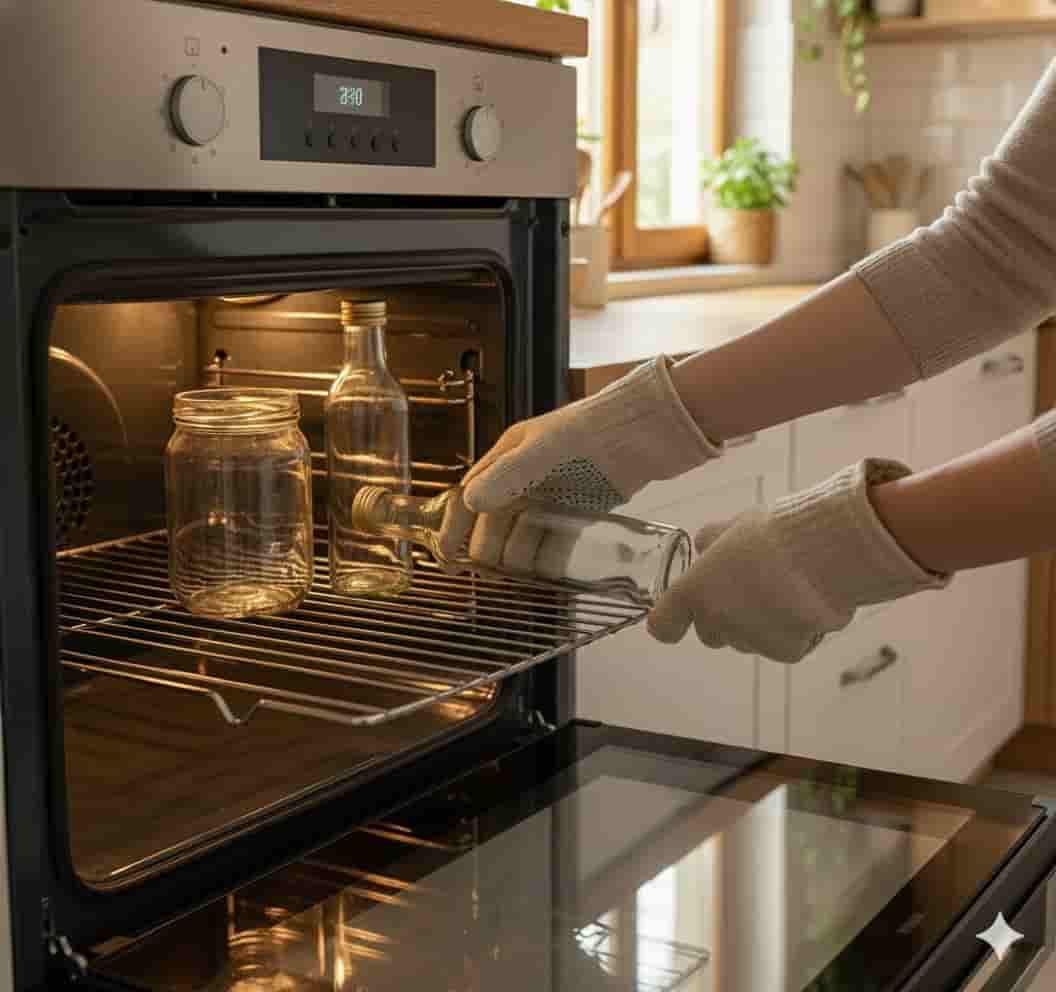
Oven sterilization is ideal when you need to prepare a large number of jars or bottles at once, as it uses dry heat to kill bacteria and microorganisms. It is a very efficient method.

Attention: This method should only be used with heat-resistant glass jars. Plastic lids must not go in the oven.

Follow the steps safely:

  • 1- Initial Cleaning: Wash the jars and bottles with detergent and hot water, removing dust, dirt, or any residues. It is crucial that the glass is clean before being exposed to heat.
  • 2- Preheat: Turn on the oven and let it preheat to 160°C. (A slightly higher temperature, like 180°C, may be excessive and unnecessary).
  • 3- Prepare the Tray: Place the jars and bottles upside down on a tray (if using a metal tray, use parchment paper to protect the base) or on a rack, ensuring they do not touch each other.
  • 4- Sterilization: Place the jars in the preheated oven for 30 minutes.
  • 5- Lids: While the jars are in the oven, sterilize the lids in a pot of boiling water (5 minutes), as they should not be exposed to the dry heat of the oven (they may melt or the rubber seal may be damaged).
  • 6- Removal: Carefully remove the jars from the oven using oven mitts and let them cool completely on a clean cloth before using them for your preserves.
  •  

Precautions:

  • 1- Do not sterilize plastic jars, bottles, or lids in the oven, as they may melt or deform.
  • 2- Do not open the oven during the sterilization process, as this can interrupt the process and allow bacteria to survive.

3. Sterilizing Jars in the Microwave

If you are looking for the fastest way to sterilize one or two jars, the microwave is the solution. This method uses steam generated by heating water (via microwave) to destroy bacteria and other microorganisms. It is extremely practical!

Quick step-by-step:

  • 1- Essential Pre-wash: Wash the glass jars with detergent and hot water. It is fundamental to remove all dirt before starting.
  • 2- Add Water: Fill the jars with a little water (about 4 to 5 centimeters at the bottom is enough).
  • 3- Heat: Place the jars in the microwave and turn it on at maximum power (800W to 1000W) for 2 to 3 minutes. The water will boil, and the steam will sterilize the inside of the jar.
  • 4- Remove: Remove the jars from the microwave (be careful, the glass will be very hot!) and drain the boiling water. Place them upside down on a clean cloth to dry and cool completely.
  •  

⚠️ Crucial Precautions

  • 1- Glass Only: Never sterilize plastic jars, bottles, or lids in the microwave, as they can melt or deform.
  • 2- Metal Lids: Metal lids must also not go in the microwave. These should always be sterilized separately in boiling water, as explained in the first method.
  • 3- Steam: The effectiveness depends on the production of steam. If the water does not come to a strong boil, add more time until you see the steam rising, ensuring the heat is sufficient to destroy bacteria.

4. Sterilizing Jars in the Dishwasher

This is by far the most practical method for sterilizing large quantities of jars, bottles, and lids all at once. The dishwasher proves to be an extremely easy and effective method, provided your appliance reaches the correct temperature for sanitization.

Follow these steps:

  • 1- Preliminary Cleaning: Ensure the jars are clean (remove labels and larger debris).
  • 2- Organize in the Machine: Place the jars, bottles, and lids (those that are high-temperature resistant) in the machine just as you would with normal dishes, making sure the openings of the jars are facing down.
  • 3- Choose the Program: Wash the jars on a high-temperature program (ideally 70°C or higher). If your machine has a specific sanitization cycle program (often called "Sanitize" or "Steam"), use it.
  • 4- Immediate Use: As soon as the cycle ends, remove the jars from the machine. They should be filled with the jam or preserve while they are still hot to maximize food safety.
  •  

⚠️ Essential Precautions

  • 1- Minimum Temperature: For the jars to be effectively sterilized, the washing program must reach or exceed 70°C. If your machine does not have this capability, you should opt for another method (such as boiling or the oven).
  • 2- Glass and Lids Only: During the process, only the jars, bottles, and lids to be sterilized should be inside the machine. Avoid using dish detergent (some types can leave residues that affect the flavor of the preserve).
  • 3- Drying: If you are not going to use the jars immediately, you can remove them from the machine and let them dry on a tray lined with absorbent paper, but remember: it is ideal to fill them while hot, as soon as they come out of the cycle.

🛍️ Already Have the Product, but Need the Packaging?

After learning how to sterilize to perfection, it is time to choose the ideal container for your preserves, sauces, or jams!

If you are looking for glass jars, bottles, or packaging that combines quality and a good price, you don't need to look any further!

In our online store, you will find exactly what you need:

  • 1- Buy in Small Quantities: We have jars and bottles with lids that you can purchase even in small quantities, perfect for those just starting out or for home production.
  • 2- Fast Delivery: Receive your order at home in record time, with a deadline of just 2 to 3 business days.
  • 3- Decoration and Accessories: We offer a wide range of packaging accessories, such as labels, ribbons, and fabrics, ideal for giving a special touch to your honey and jam jars, or for creating truly memorable wedding, baptism, or communion favors.

Espírito Rebelde Glass Jars and Bottles: The Ideal Packaging Glass is the material of choice for storing your creations and mixtures.

Choosing Espírito Rebelde glass jars and bottles means opting for purity, hygiene, and versatility. Glass is a neutral material that does not react with ingredients, ensuring that your product—whether it is a preserve, a serum, or a liqueur—maintains its flavor, aroma, and properties intact, without any contamination.

Espírito Rebelde Glass Jars and Bottles: The Ideal Packaging Glass is the material of choice for storing your creations and mixtures.

Choosing Espírito Rebelde glass jars and bottles means opting for purity, hygiene, and versatility. Glass is a neutral material that does not react with ingredients, ensuring that your product—whether it is a preserve, a serum, or a liqueur—maintains its flavor, aroma, and properties intact, without any contamination.